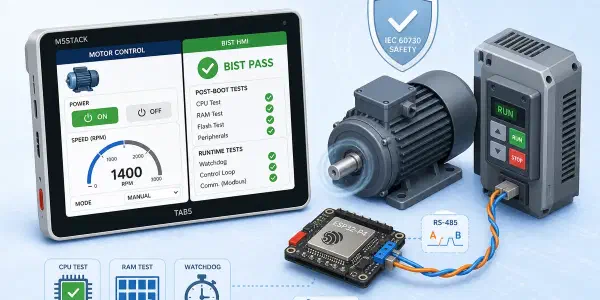
ESP-BIST brings IEC 60730 Class B self-test coverage to Espressif SoCs, and this article walks through what that actually means before putting it to work. Using an ESP32-P4-based M5Stack Tab5 as a Modbus HMI for a simulated motor controller, we show how a SoC that can prove its own health is a chip you can trust to draw a “safe” screen without lying about it.
This guide demonstrates how to integrate external libraries into NuttX applications using static libraries and cross-compilation. Learn how to build a library on x86, integrate it into the NuttX simulation environment, and cross-compile for RISC-V targets like the ESP32-C6, all without moving your entire codebase into the NuttX directory structure.
This guide explores how to utilize flash memory for persistent data storage in NuttX-based embedded systems, covering SPI Flash fundamentals, file system options (SmartFS, SPIFFS, LittleFS), and practical implementation of a boot time logging application with Wi-Fi and NTP synchronization.
This article extends the NuttX motor control system with inertial measurement unit (IMU) sensor integration for vibration measurement and wireless data streaming capabilities using the ESP32-C6 Wi-Fi connectivity.
This article demonstrates how to implement motor control and speed sensing on an ESP32-C6 using NuttX RTOS. It covers setting up MCPWM for motor control, ADC for potentiometer reading, and quadrature encoder for speed measurement. The implementation showcases NuttX’s real-time capabilities through a practical example using common peripherals and sensors.