

Introduction to the Cyber Resilience Act (CRA)#
The European Union’s Cyber Resilience Act (CRA) represents a fundamental shift in how cybersecurity is regulated for connected products placed on the EU market. Like the RED Delegated Act clarified cybersecurity expectations for radio equipment, the CRA establishes horizontal cybersecurity requirements for a broad range of digital products — including IoT devices and digital products built on ESP32 SoCs and modules, as well as related software frameworks (such as ESP-IDF), companion mobile applications, and associated cloud offering as part of the overall product solution.
As an EU Regulation, it becomes directly binding law across all Member States once it enters into force. The same legal text applies uniformly across the entire EU, ensuring consistent cybersecurity obligations in every country.
For manufacturers, this means the CRA creates a single, harmonized cybersecurity framework for the entire EU market. Product manufacturers can follow one common compliance plan for the entire EU instead of preparing different plans for each country.
Scope of the CRA#
The CRA applies broadly to:
- Hardware and software products with digital elements (e.g., smart home hubs, network-connected printers)
- IoT devices and connectivity modules (e.g., smart thermostats, Wi-Fi or BLE modules integrated into consumer devices)
- Embedded systems with network interfaces (e.g., industrial controllers, smart meters)
- Firmware and software components supplied with the product (e.g., device operating systems, companion mobile applications provided with the device and cloud deployment)
Products already regulated under sector-specific EU frameworks (e.g., medical devices, automotive under UNECE, aviation) may have partial or full exemptions where equivalent cybersecurity requirements already exist.
For typical ESP32-based designs — such as smart home devices, industrial sensors, wearables, gateways, and consumer IoT products — the CRA is applicable.
CRA Timeline#
The CRA was politically agreed in 2023 and has entered into force in December 2024.
Key milestones:
- Entry into force: 10 December 2024 (20 days after publication in the Official Journal of the EU)
- Vulnerability reporting obligations apply from: 11 September 2026 (21 months after entry into force)
- Full application of core CRA requirements from: 11 December 2027 (36 months after entry into force)
Manufacturers placing products on the EU market should begin gap analysis and implementation planning early.

Essential CRA Requirements#
The CRA defines essential cybersecurity requirements that manufacturers must meet before placing products on the EU market. These obligations extend beyond firmware design. They impact provisioning flows, lifecycle management, update strategy, documentation, and post-market processes.
Cybersecurity Requirements for Products with Digital Elements#
Annex I Part I of the CRA defines a set of baseline cybersecurity requirements that must be implemented in the design and development of products with digital elements. In simple terms, manufacturers must ensure that products are built with security in mind from the beginning.
Key high-level requirements include:
- Secure-by-design and secure-by-default development
- Cybersecurity risk assessment at product level
- Protection against unauthorized access and misuse
- Secure update mechanisms
- Vulnerability handling and coordinated disclosure processes
- Data protection and minimization principles
- Logging and monitoring capabilities (where relevant)
- Transparency obligations (security documentation and instructions)
Vulnerability Handling Requirements#
Annex I PART II of the CRA also defines requirements for how manufacturers must handle vulnerabilities discovered during the product lifecycle.
Manufacturers must establish processes to identify, manage, and remediate vulnerabilities affecting their products. In particular, the CRA introduces two reportable security conditions:
- Actively exploited vulnerability – a vulnerability that is currently being exploited in the product
- Severe incident – a security incident that significantly impacts the security of a product or its users
To address these situations, manufacturers are expected to:
- Maintain a vulnerability handling and coordinated disclosure process
- Monitor and assess vulnerabilities reported by researchers, customers, or internal teams
- Provide vulnerability fixes and security updates for the declared support period of the product
- Inform users about available security updates and mitigation measures
- Maintain communication channels for vulnerability reporting
- Establish processes to assess and report actively exploited vulnerabilities and severe incident
- Submit reports through the Single Reporting Platform (SRP) designated under the CRA. The SRP forwards the notifications to ENISA and the relevant national CSIRTs and market surveillance authorities, ensuring coordinated incident handling across the EU
- Follow CRA vulnerability notification timelines:

For more details on managing security lifecycle in ESP32 products, please see the related blog.
CRA Compliance Process#
The CRA introduces a structured conformity assessment framework.
Step 1: Product Classification#
Under the CRA (see Annex III & Annex IV), products are categorized as:
- Default (non-critical) products
- Important products (Class I and Class II)
- Critical products (subject to stricter conformity assessment)
Most ESP32-based IoT products are expected to fall under the Default or Important Class I category, depending on functionality and risk profile.
Step 2: Conformity Assessment#
Manufacturers must:
- Perform cybersecurity risk assessment
- Implement required technical and organizational measures
- Prepare technical documentation
- Draft an EU Declaration of Conformity
- Affix CE marking (including CRA compliance)
Certain product categories may require third-party conformity assessment by a Notified Body.
CRA Product Classes and Compliance Process#

Step 3: Post-Market Obligations#
Compliance does not end at market entry. Manufacturers must:
- Monitor vulnerabilities
- Issue security updates
- Maintain vulnerability handling procedures
- Notify ENISA of actively exploited vulnerabilities
The CRA establishes lifecycle-based cybersecurity accountability.
Obligations: OEM vs. Platform Vendor#
OEM (Product Manufacturer) Obligations#
The OEM placing the final product on the EU market is legally considered the manufacturer under the CRA. As per CRA Article 13 and Article 14, manufacturers are responsible for:
- Conducting product-level cybersecurity risk assessment
- Ensuring compliance with the CRA essential cybersecurity requirements
- Maintaining vulnerability management and disclosure processes
- Providing required CRA compliance and technical documentation (including user cybersecurity information, support period, update policy, and vulnerability contact)
- Defining support period and update policy
- Preparing technical documentation and EU Declaration of Conformity
Even when using certified modules or open-source frameworks, responsibility for final product compliance remains with the OEM.
Platform Vendor Obligations#
Platform vendors supply components, platforms, or software frameworks that are integrated by manufacturers into final products. While the OEM placing the product on the EU market remains the legal manufacturer, platform vendors are expected to support the security posture of the ecosystem.
Typical responsibilities of a platform vendor include:
- Designing hardware and software platforms with built‑in security capabilities
- Providing documentation of available security features and recommended secure configurations
- Maintaining a vulnerability handling and disclosure process for the platform
- Informing downstream manufacturers about vulnerabilities that may affect their products
- Providing security update or vulnerability fixes for supported platform components
- Publishing security advisories and guidance when vulnerabilities are identified
These practices help manufacturers integrate the platform securely and meet their CRA obligations.
How Espressif Will Support OEM Customers for CRA Compliance#
Espressif is committed to supporting customers in meeting CRA cybersecurity requirements across the full product lifecycle — from secure design to post-market vulnerability management.
Cybersecurity Requirements#
Espressif provides platform capabilities and guidance that help OEMs address CRA essential cybersecurity requirements (Annex I Part I) across design, development, and deployment:
Secure hardware capabilities hardware root-of-trust, secure boot, flash encryption, secure key storage (eFuse), and cryptographic accelerators and other proprietary security peripherals to provide a secure hardware foundation for the product
Secure software framework (ESP-IDF) as an open-source, actively maintained platform with regular security patches, secure OTA update mechanisms, industry-standard cryptographic libraries, and coordinated vulnerability disclosure
Documentation and compliance guidance including security application notes, production configuration guidelines, reference architectures for secure provisioning, and alignment with CRA requirements and future harmonized standards
Collaboration and customer support including secure configuration guidance, lifecycle management best practices, and support for certification activities
Espressif maintains a comprehensive product security program. More details please refer Espressif Product Security page.
Vulnerability Management#
Espressif provides processes, supported by transparent mechanisms and tools, to help OEMs implement vulnerability handling requirements (Annex I Part II) aligned with CRA:
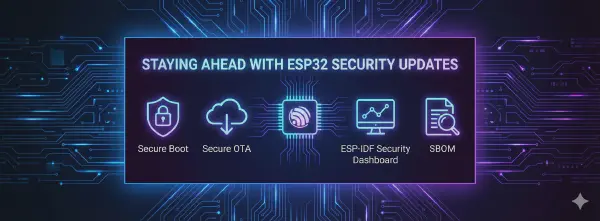
SBOM (Software Bill of Materials) support to track third-party components and assess vulnerability impact
ESP-IDF Security Dashboard to monitor vulnerabilities, affected components, and fixes
Espressif Security Incident Response Process with coordinated disclosure practices and publish security advisories
Long-Term Support (LTS) releases with sustained security updates and maintenance over defined support lifecycles, aligned with Espressif support policy and defined maintenance periods
Secure OTA update mechanisms to enable authenticated, integrity-protected, and reliable delivery of security patches throughout the product lifecycle
For additional details on vulnerability management and the security lifecycle for ESP32 products, see the related blog.
Final Thoughts#
The Cyber Resilience Act represents a structural evolution in EU product regulation. Cybersecurity is no longer optional or market-driven — it is a legal requirement spanning the entire product lifecycle.
For OEMs building on ESP32 platforms, early preparation is critical:
- Conduct a gap analysis
- Define update and vulnerability handling processes
- Enable hardware security features in production
- Maintain comprehensive technical documentation
Espressif Systems remains committed to delivering secure SoCs, secure software frameworks, and transparent security practices to help customers confidently place CRA-compliant products on the EU market.
Cybersecurity is not just regulatory compliance — it is product quality, customer trust, and long-term sustainability.
For assistance, customers can contact sales@espressif.com.
Frequently Asked Questions (FAQ)#
Q1: Does the CRA apply only to connected IoT devices?
A: No. The CRA applies to all “products with digital elements,” which includes hardware, embedded software, standalone software, and digital services supplied as part of a product solution.
Q2: When will harmonized standards supporting the CRA be available?
A: Most harmonized standards expected to start publishing by end of the year 2026.
Q3: Should a product comply with both the CRA and RED Delegation Act after CRA comes into the force?
A: The CRA will also apply to the same categories of radio equipment currently covered by the RED DA. These products must follow RED DA cybersecurity rules if placed on the market between 1 August 2025 and December 2027 and will follow CRA rules if placed on the market from December 2027 onward. Even after the RED DA is repealed, market surveillance will continue to check compliance for products sold during that earlier period.
Q4: For how long must a manufacturer provide security updates?
A: Manufacturers must provide security updates for the declared support period, aligned with the product’s expected lifetime. As a general rule, this period should be at least 5 years from when the product is placed on the market, unless a shorter period is justified by the product’s intended use or lifecycle. The support period and update commitments must be clearly communicated to users at the time of purchase.
Q5: Do products already placed on the market need to comply with the CRA?
A: Products placed on the EU market before the CRA’s full application date (11 December 2027) are generally not retroactively affected. Products placed on the market after that date must fully comply with the CRA requirements. However, any product placed on the market after 11 September 2026 must already follow the vulnerability reporting obligations under Article 14 of the CRA.
Q6: How should OEMs handle vulnerabilities in ESP32-based products?
A: OEMs should establish a structured vulnerability management process aligned with CRA requirements. This includes monitoring Espressif security advisories and the ESP-IDF Security Dashboard, assessing impact using SBOM data, applying fixes or mitigations, and deploying updates through secure OTA mechanisms. OEMs should also maintain internal tracking, coordinate disclosure where required, and ensure timely reporting of actively exploited vulnerabilities or severe incidents in line with CRA Article 14 obligations.