

The world of connected devices is evolving rapidly, and so are the expectations. With regulations like the EU Cyber Resilience Act (CRA) coming into effect, the industry is shifting its focus from just delivering products to also maintaining them throughout their lifecycle.
For product manufacturers, this presents a new challenge: How do we build firmware that is not only secure at launch but remains compliant for years? This post explores how the ESP32 ecosystem supports this lifecycle through specific tools, LTS branches, and vulnerability management strategies.
Continuous Security#
Continuous vigilance is now a regulatory requirement. As threats evolve, so must your firmware. Under emerging regulations like the CRA, it is not enough to launch with secure firmware — you must ensure:
- Vulnerabilities are identified throughout the device lifecycle.
- Fixes are promptly delivered via secure OTA updates.
- Firmware remains actively maintained and supported.
To support developers on this path, Espressif maintains a transparent posture through its vulnerability management processes.
Espressif’s Approach to Vulnerability Management#
Transparency is a core part of Espressif’s security posture. When vulnerabilities are discovered, Espressif follows a well-defined Security Incident Response Process to assess, communicate, and remediate issues promptly.
Espressif encourages coordinated vulnerability disclosure and maintains strict confidentiality during the investigation and remediation process. Public advisories are published on the official website or respective software framework repository (e.g., ESP-IDF Repository) as applicable. But how can a developer quickly determine if their specific device is affected?
Know Your Exposure: Security Dashboard & SBOM#
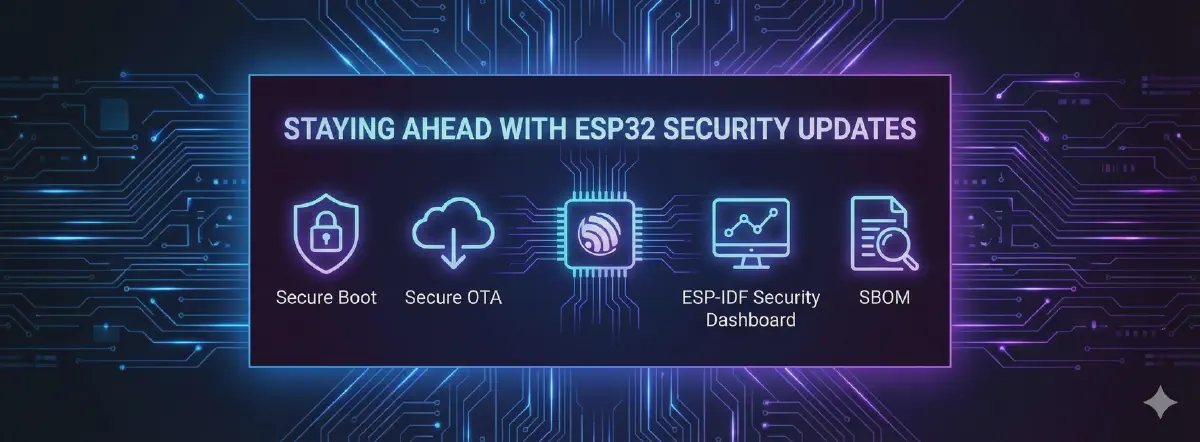
Use the ESP-IDF Security Dashboard — a public vulnerability database that maps all known CVEs to their impacted ESP-IDF versions. This dashboard is your go-to for:
- Quickly identifying affected releases
- Tracking patched versions
- Performing periodic firmware audits
While the dashboard provides visibility into known ESP-IDF vulnerabilities, understanding your full exposure requires a complete inventory of your firmware components. The esp-idf-sbom tool generates a Software Bill of Materials (SBOM) for your project, enabling you to cross-reference your actual dependencies against the dashboard data. For a detailed guide on generating and managing SBOMs, see the Software Bill of Materials blog post.
This visibility is essential for ongoing vulnerability management required under CRA, RED-DA and similar global frameworks. Once a vulnerability is identified via the dashboard, the next step is obtaining a stable, secure patch.
Leveraging Long-Term Support (LTS)#
Espressif helps maintaining the product lifecycle through a clearly defined support policy that includes:
- Long-Term Support (LTS) branches: Receive critical security fixes for at least 30 months.
- Security-Only maintenance: Past the feature freeze, only vulnerability patches are delivered to ensure continued protection.
- Transparent release cadence: The ESP-IDF version table helps you plan your maintenance and upgrades confidently.
Shipping with an LTS version means building on a foundation designed for long-term regulatory compliance. These fixes, however, are only effective if they can be reliably deployed to devices already in the field.
The Role of Over-the-Air (OTA) Updates#
Even if the product is free from any known vulnerability, new vulnerabilities may be discovered later. An effective Over-the-Air (OTA) update mechanism is the primary defense for devices in the field, acting as the delivery vehicle for the patches provided in the LTS branches.
ESP-IDF includes the esp_https_ota component, which supports:
- Secure Upgrades: Using HTTPS and digital signatures.
- Rollback Protection: Preventing the device from being downgraded to a vulnerable version.
- Anti-rollback: Ensuring that a device cannot be updated to an older, insecure firmware version.
For a deep dive into the OTA updates framework internals including partition layout, rollback, and anti-rollback mechanisms, see the OTA Updates Framework blog post.
Implementing these features ensures that when a patch is ready, it can be deployed safely and reliably.
Secure Product Lifecycle in Practice#
To help your organization stay compliant and build resilient products, you may consider this security maintenance loop:
Pre-Launch: Verify Before You Ship#
- Run a final security audit using
esp-idf-sbomto generate an up-to-date SBOM. - Check against known CVEs for the selected ESP-IDF version using the security dashboard.
- Confirm no known vulnerabilities are present in your release firmware.
Post-Launch: Monitor and Mitigate#
- Periodically scan the SBOM and compare against the latest ESP-IDF security dashboard data.
- When a vulnerability is found, roll out secure OTA update using secure update mechanisms supported by ESP-IDF.
- Leverage LTS branches for critical patches without needing major upgrades.
Maintain Compliance Across the Lifecycle#
- Continue assessments and updates throughout the support period of the product.
- Maintain your SBOM, overall Vulnerability Disclosure Program (VDP), update policy, and remediation plan — regulatory bodies will look for these during audits.
- For detailed guidance on meeting RED-DA (EN 18031) requirements, refer to the compliance guide series: Part 1 and Part 2.
Conclusion#
Security compliance requires ongoing discipline across the entire lifecycle of product.
By using ESP-IDF’s long-term support policy, staying updated via the vulnerability dashboard, and embracing secure OTA mechanisms, you’re not just protecting your devices — you’re building trust, resilience, and regulatory readiness into every product you ship.
Espressif’s commitment to security extends beyond software. Alignment with programs like PSA Certified and the CSA Product Security Certification further validates the security foundations available to product developers in the ESP32 ecosystem.
For questions about product security or compliance readiness, please browse through our Product Security Portal or reach out to us at sales@espressif.com