
Introduction#
ESP-IDF ships with lwIP, and for most projects that’s the right choice. It’s mature, well documented, and every networking component in ESP-IDF is built and tested against it. Nothing below is an argument to replace it by default.
Still, there are two reasons you might want an alternative. The first is the implementation language: the IP stack is the part of your firmware that parses bytes arriving from machines you don’t control, and lwIP is written in C. The second is the concurrency model — lwIP runs several tasks and takes a fair number of mutexes, which is harder to reason about when you need confidence that a device will stay up for months without intervention.
Why a second TCP/IP stack#
smoltcp is a #![no_std] TCP/IP
stack written in Rust, with no heap requirement and a single, explicit poll
model: you give it the current time and a device to read and write frames,
it does one pass of work, and you call it again. The packet parsing is safe
Rust, and there’s no background thread operating on the stack behind your
code.
Now, getting smoltcp to run on an ESP32 is not the hard part. The hard part
is running it under ESP-IDF without giving up the native networking stack
you already depend on — esp_http_server, esp-tls, esp_http_client,
esp-mqtt, mbedTLS. If switching stacks means forking all of that, it’s a
toy. So the goal was source compatibility: keep those components, and the
application code that uses them, completely unchanged.
That turned out to be achievable, and verified on real hardware at roughly wire-line speed. This article goes through how it works and where the edges are.
How compatibility works: a linker --wrap shim#
Every ESP-IDF networking component eventually calls BSD sockets — socket(),
bind(), listen(), accept(), send(), recv(), select(),
getaddrinfo(). In ESP-IDF, these come from <lwip/sockets.h>, and the
key detail is that they are defined as static inline wrappers:
/* lwip/sockets.h, simplified */
static inline int socket(int domain, int type, int protocol) {
    return lwip_socket(domain, type, protocol);
}
static inline int bind(int s, const struct sockaddr *name, socklen_t len) {
    return lwip_bind(s, name, len);
}
So when esp_http_server calls socket(), the symbol that actually ends
up in the link is lwip_socket(). That’s the seam the whole project hangs
on.
GNU ld provides --wrap=symbol: every reference to symbol is redirected
to __wrap_symbol, and the original remains reachable as __real_symbol.
The component adds one of these for each BSD-socket entry point:
-Wl,--wrap=lwip_socket
-Wl,--wrap=lwip_bind
-Wl,--wrap=lwip_listen
-Wl,--wrap=lwip_accept
-Wl,--wrap=lwip_send
-Wl,--wrap=lwip_recv
-Wl,--wrap=lwip_select
/* ... and so on for the full BSD-socket surface */
With that in place, every BSD-socket call site across ESP-IDF — none of which is modified — lands in a thin C shim that talks to smoltcp instead. lwIP is still compiled into the image, because its headers define types the ESP-IDF networking source needs, but its socket layer is never reached at runtime. The application source change required to switch stacks is zero.
Using it#
The intended workflow is “install your own Ethernet driver, hand over the
handle, and let the component take it from there.” You bring up esp_eth
the way your board requires — pins, PHY, clocks, all board-specific — and
then attach it:
#include "esp_smoltcp.h"

void app_main(void)
{
    nvs_flash_init();
    esp_event_loop_create_default();

    /* Your driver, your pins. The stack does not need to know the details. */
    esp_eth_handle_t eth = my_install_eth_driver();

    esp_smoltcp_init();
    esp_smoltcp_attach_eth(eth);
    esp_smoltcp_wait_for_ip(ESP_SMOLTCP_IFACE_ETH, 15000);  /* DHCP by default */

    /* BSD sockets work from here, so unmodified ESP-IDF code works too: */
    httpd_handle_t server;
    httpd_config_t config = HTTPD_DEFAULT_CONFIG();
    httpd_start(&server, &config);
    /* register handlers as usual */
}
httpd_start() and everything beneath it are stock ESP-IDF. They just happen
to be running on smoltcp now.
Architecture#
The implementation is three components stacked on top of each other:
  esp_http_server | esp-tls | esp-mqtt | mdns   (unchanged ESP-IDF source)
                         |
              BSD sockets: socket/bind/recv/select/getaddrinfo
                         |
   +---------------------v---------------------+
   |  esp_smoltcp_lwip_compat                  |  linker --wrap shim:
   |  FD table, select scan, getaddrinfo,      |  rewrites every lwip_* call
   |  esp_netif shim, in-RAM 127.0.0.0/8       |  to __wrap_lwip_*; provides
   |  loopback for httpd's control socket      |  an in-RAM loopback
   +---------------------+---------------------+
                         |
   +---------------------v---------------------+
   |  esp_smoltcp                              |  single poll task owns the
   |  poll loop, slab-allocated RX frame pool, |  stack; FreeRTOS event-group
   |  L2 frame tap, per-interface stats, SNTP  |  wakeups; per-iface counters
   +---------------------+---------------------+
                         |
   +---------------------v---------------------+
   |  esp_smoltcp_glue                         |  Rust no_std staticlib,
   |  smoltcp 0.12 + DNS resolver + C FFI      |  riscv32imafc-unknown-none-elf
   +---------------------+---------------------+
                         |
            esp_eth_handle_t  (your driver, attached above)
Three decisions shape how this behaves under load:
A single task owns the stack. There’s one poll loop. It blocks on a
FreeRTOS event group, wakes when a frame arrives or a socket needs service,
runs exactly one iface.poll() pass, and goes back to sleep. Because
nothing else ever touches smoltcp, there are no locks protecting it. The
BSD shim marshals work onto that task instead of reaching into the stack
from arbitrary contexts.
RX frames come from a slab pool, not the heap. The pool is fixed in
size and count and allocated once. Under load that gives you bounded RAM
and an explicit drop counter (esp_smoltcp_frame_pool_drops()) instead of
heap fragmentation and a mystery. If the pool runs dry, that’s a number you
can read, not a leak you have to hunt.
The Rust side is no_std with an internal-RAM-first allocator, built
for riscv32imafc-unknown-none-elf to match the ESP32-P4 high-performance
cores (hard float, compressed instructions). The TX scratch buffer is a
static pool. The pinned toolchain is recorded in a rust-toolchain.toml,
so rustup selects it automatically.
Performance#
The hardware is a
Waveshare ESP32-P4-Nano with
the built-in 100 Mbit/s EMAC, ESP-IDF v6.0, MTU 1500. The example application serves a synthetic
download endpoint; the measurement is a 200 MB transfer pulled with curl
(curl reports it as 190M because it counts in MiB):
$ curl http://<ip>/dl/200000000 --output foo
100  190M    0  190M    0     0  10.8M     0  --:--:--  0:00:17  --:--:--  10.8M

# the server logs, after the transfer completes:
I (...) app: dl: 200000000 bytes in 17552922 us = 91.15 Mbit/s
That’s 91.15 Mbit/s sustained. The practical ceiling on a 100 Mbit link at MTU 1500, after Ethernet, IP and TCP framing, is about 94.85 Mbit/s, so this is roughly 96% of the realistic maximum; the remaining few percent is framing overhead that nothing can get back. Across the 200 MB transfer there were 0 TX failures and 0 frame-pool drops, and round-trip ping on the wire sits at 0.4–0.7 ms.
To be clear, that number is the result of tuning, not the first run. Getting there took a 1 kHz FreeRTOS tick so the poll loop is serviced often enough, enabling the EMAC hardware flow control, and moving the hot path into IRAM so it isn’t stalled on flash access. A throughput figure without its conditions isn’t worth much, so those are the conditions.
Footprint vs lwIP#
Throughput is only half the story; the other half is what it costs. The
numbers below are from idf.py size-components on an ESP32-C3 build with
default config (measured by David Cermak while reviewing this article —
thanks for that):
| Archive | Flash code | Static RAM (.data + .bss) |
|---|---|---|
libsmoltcp_glue.a (Rust stack + FFI) | 82.2 KiB | 24.6 KiB |
libesp_smoltcp.a (poll task, frame pool) | 3.4 KiB | 49.9 KiB |
| smoltcp total | ~85.6 KiB | ~74.5 KiB |
liblwip.a | 47.4 KiB | ~1 KiB |
So smoltcp costs about 38 KiB more flash, and on paper ~73 KiB more RAM.
The RAM comparison needs one caveat to be fair in both directions: the
smoltcp figure is the whole budget, allocated statically up front — the
24.6 KiB .data is the TX scratch pool and the 49.9 KiB .bss is the RX
slab and socket buffers, and it never grows past that. lwIP’s ~1 KiB static
figure excludes everything it allocates from the heap at runtime (pbufs,
PCBs, socket buffers), so its real RAM use under load is well above 1 KiB
and varies with traffic. A proper apples-to-apples comparison needs runtime
heap watermarks under identical load, which I haven’t measured yet — until
then, read the table as “smoltcp pre-pays a fixed, bounded RAM budget;
lwIP pays a smaller but variable one as it goes.”
On an ESP32-P4 the totals are negligible either way; on smaller chips the ~75 KiB of static RAM is a real line item and the main reason to think twice.
One version-specific caveat: select() and the VFS#
The released v0.1.x requires CONFIG_VFS_SUPPORT_SELECT=n in your
sdkconfig. The short reason: ESP-IDF’s select() doesn’t go through a symbol
that --wrap can intercept — the VFS layer dispatches it through a
per-FD-range function-pointer table that lwIP populates at init, so smoltcp
sockets were invisible to it. Disabling VFS select sidesteps the table.
v0.2 (currently 0.2.0-rc.1 on the registry) removes the constraint
properly: the component claims the BSD-socket FD range with
esp_vfs_register_fd_range() and provides its own esp_vfs_select_ops_t,
so select() dispatches through the VFS the way ESP-IDF intends and the
default CONFIG_VFS_SUPPORT_SELECT=y just works. The design history —
including how this fix came out of the review discussion — is in the
RFC on the esp-idf tracker.
Current status and limitations#
What is verified and in use:
- BSD sockets,
select()/poll(), and the fullesp_http_serverstack including chunked encoding and WebSockets esp_https_serverwith mbedTLS, plusesp-tls,esp_http_clientandesp-mqtt, all over BSD sockets and all unchanged- An in-RAM
127.0.0.0/8loopback —esp_http_server’s internal control socket needs one, and loopback traffic is forwarded entirely in RAM instead of going out through the Ethernet driver - IGMPv2 multicast, ICMP echo, and IPv6 link-local with ping6 and NDP/ICMPv6
- A raw L2 frame tap for PTP, LLDP and custom EtherTypes, with the P4 hardware timestamp wired up
- Per-interface statistics and the frame-pool drop counter
And what I’m not claiming:
- Only the ESP32-P4 is hardware-verified. Other RISC-V SoCs should work; the classic Xtensa ESP32 needs a different Rust target and hasn’t been done.
- The ESP-Hosted Wi-Fi path is scaffolded but not yet flashed. The code exists; until it’s proven on hardware it stays listed as untested.
- No SLAAC and no DHCPv6. IPv6 support is link-local plus the native socket API. smoltcp doesn’t ship a Router-Solicitation client and I haven’t written one yet.
- The bundled DNS resolver is minimal — single-shot, A-records only. Production use should bring its own resolver.
For a sense of how hard the working list has been exercised: the
socket-handle map used to run out of slots after about 24 connections until
it got proper recycling, and an early select() implementation spun on a
vTaskDelay(1) until it was made event-driven. Both are fixed — and
finding that class of bug is what separates “works” from “demo”, which is
why I mention them.
When to use it#
Choose this if the safety properties of a Rust IP stack matter for your project, or if a single predictable poll loop with bounded RAM and explicit drop counters fits your reliability requirements better than lwIP’s threaded model. Those are the two cases it was built for.
Stay on lwIP otherwise. It integrates with the whole ecosystem, it’s thoroughly documented, and “already present and proven” is a strong argument on its own. The aim here is to make the alternative exist, not to argue that everyone should switch.
Getting started#
One prerequisite beyond a working ESP-IDF setup: the Rust toolchain,
because the glue component runs cargo during the build. If you don’t have
it yet, rustup is the standard installer:
curl --proto '=https' --tlsv1.2 -sSf https://sh.rustup.rs | shThat’s all the Rust setup there is — the component pins its exact toolchain
in a rust-toolchain.toml, so on the first build rustup fetches the
right nightly and the RISC-V target on its own.
The components themselves are on the ESP Component Registry:
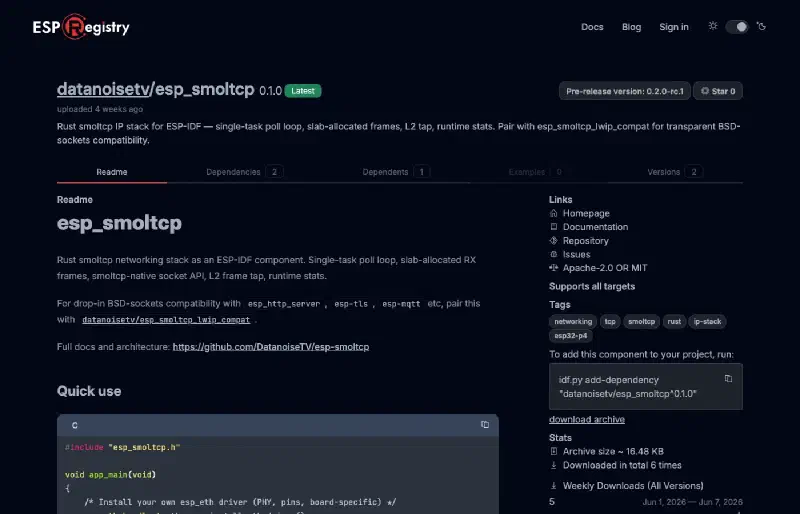
Adding them to a project is two lines:
idf.py add-dependency "datanoisetv/esp_smoltcp^0.1.0"
idf.py add-dependency "datanoisetv/esp_smoltcp_lwip_compat^0.1.0"
(Use at least esp_smoltcp_lwip_compat 0.1.1 — 0.1.0 had two packaging
bugs that broke standalone installs, found during the review of this very
article. The ^0.1.0 range above resolves to 0.1.1 automatically.)
Then set the required options in your project’s sdkconfig.defaults:
CONFIG_LWIP_COMPAT_ENABLE=y     # turn the BSD-sockets shim on
CONFIG_LWIP_NETIF_LOOPBACK=y    # esp_http_server compile-time check
CONFIG_VFS_SUPPORT_SELECT=n     # v0.1.x only — see the select() section
The option CONFIG_VFS_SUPPORT_SELECT is the v0.1.x constraint explained
above; the v0.2 release candidate doesn’t need it.
- Source, the complete
eth_basicexample, and architecture notes: github.com/DatanoiseTV/esp-smoltcp - Registry pages: esp_smoltcp and esp_smoltcp_lwip_compat
- Design RFC and discussion: esp-idf#18549
If you run it on hardware I haven’t tested — another RISC-V SoC, or the ESP-Hosted Wi-Fi path — I’d genuinely like to hear how it went, working or not. At this stage the failure reports are the more valuable ones.