

Introduction#
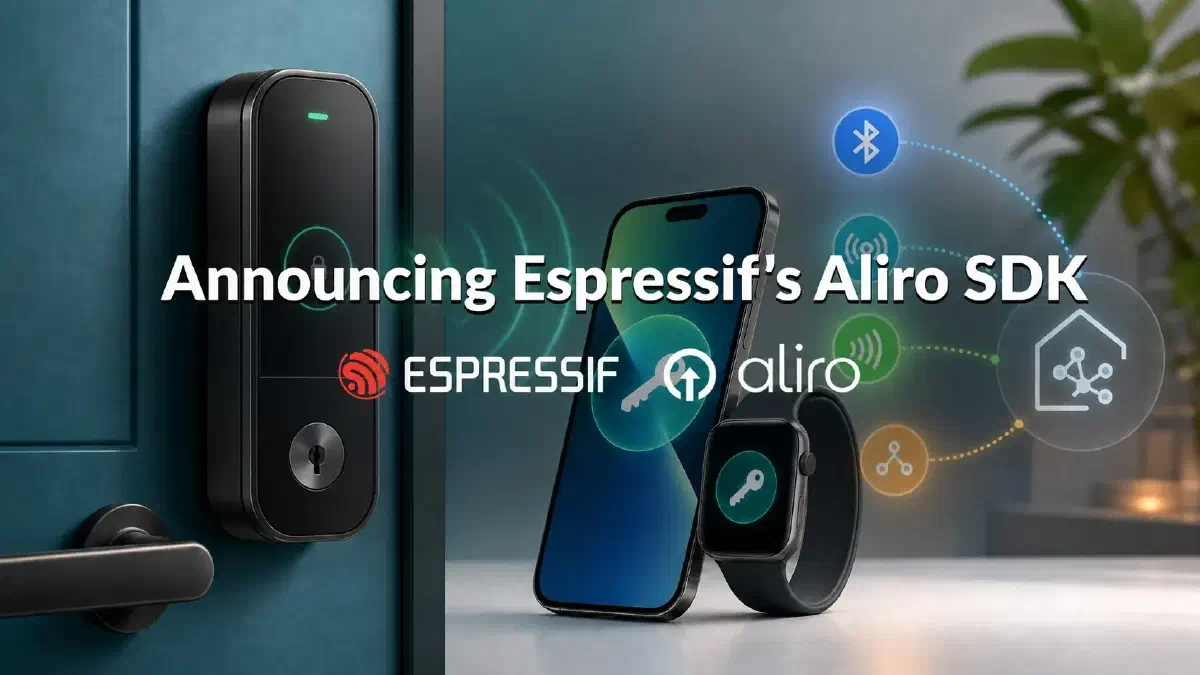
Developed by the Connectivity Standards Alliance (CSA), Aliro is a standardized protocol for mobile access credentials. It enables smartphones and wearables to act as digital keys for smart locks and access readers across residential, enterprise, hospitality, and campus scenarios.
Aliro supports multiple transports and physical interaction models. Products can choose the transport that best fits their user experience:
- NFC: for tap-to-unlock
- Bluetooth LE: for longer-range user-initiated access
- Bluetooth LE + UWB: for secure hands-free access
At the access point, Aliro defines two primary roles:
- User Device: a phone or wearable that stores and presents an access credential.
- Reader: the embedded device at a door, gate, elevator, turnstile, cabinet, or other access point. It verifies the information provided during an Aliro transaction and decides whether to grant access.
Aliro Configuration and Transaction#
Reader Configuration#
Before the Reader can validate credentials, a trusted access-management system or product configurator provisions its key pair and group identifier. This provisioning takes place outside the local Aliro access transaction.
Access Transaction Flow#
To verify credentials and make an access decision, the Reader and User Device initiate an access transaction that always starts with the Expedited phase. The Expedited phase can run in expedited-standard or expedited-fast mode. If the Reader needs signed access data, it can continue with the optional Step-up phase.
- Expedited-standard phase
The expedited-standard phase is mandatory. It establishes fresh session keys from ephemeral key material, authenticates the Reader to the User Device, and lets the User Device return an authenticated credential proof to the Reader.
- Expedited-fast phase
After a successful expedited-standard phase, the Reader and User Device can use a previously established persistent key to reduce the number of commands in a later transaction. If the Reader cannot validate the cryptogram, it can fall back to expedited-standard or terminate the transaction.
- Step-up phase
The Step-up phase is optional and can only follow the expedited-standard phase. The Reader uses this phase when it needs an Access Document or Revocation Document before making the final access decision.
Espressif’s Aliro SDK#
We are excited to introduce Espressif’s Aliro SDK, esp-aliro, with initial support for Aliro over NFC. Bluetooth LE and UWB support are planned for a future release.
The solution enables developers to build interoperable smart locks and access control products using Espressif Wi-Fi or Thread SoCs, together with an NFC frontend and a lock actuator. The SDK supports all Matter-enabled Espressif chipsets, including the ESP32, ESP32-C, ESP32-S, and ESP32-H series.
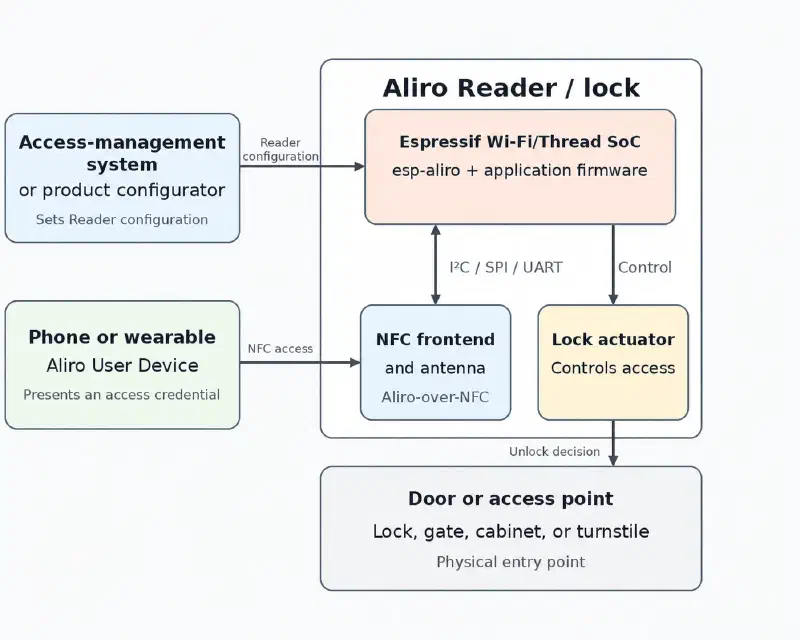
To get started, refer to the Aliro reader example, which demonstrates how to build an Aliro Reader and test with an Aliro User Device. In this example, the Aliro Reader is configured with a fixed key pair and group identifier. In a production access point, an access manager should configure the Reader through Matter or another application protocol.
Aliro + Matter#
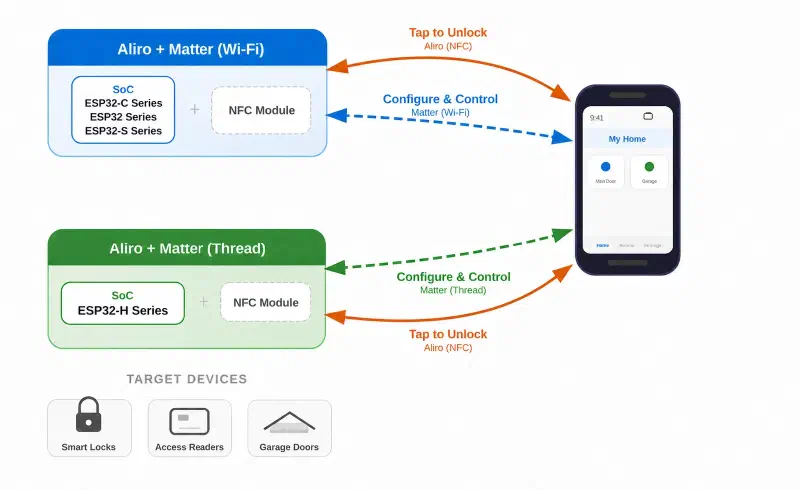
Matter and Aliro are complementary. Matter provides the smart home commissioning, control, and management path via Wi-Fi or Thread, while Aliro provides the local digital-key transaction between the User Device and Reader.
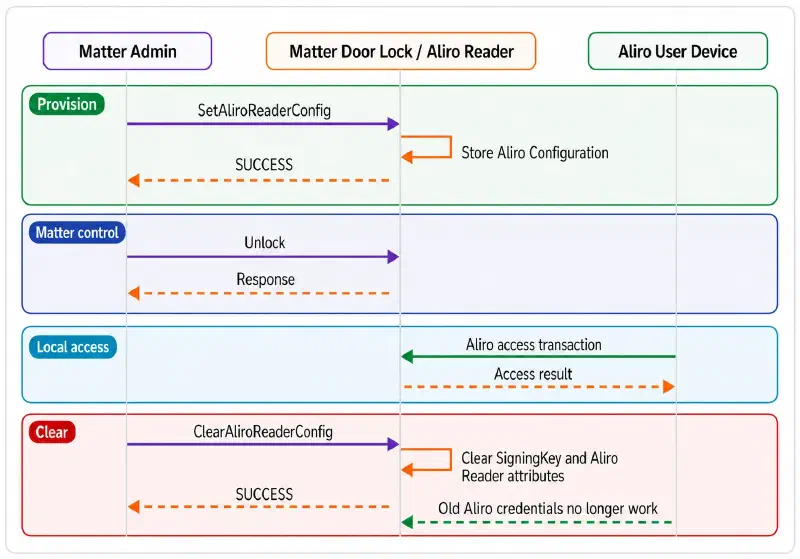
A Matter administrator can set or clear the Aliro Reader’s configuration using the SetAliroReaderConfig and ClearAliroReaderConfig commands in the Door Lock cluster.
For an implementation example, see the Matter door lock example, which demonstrates a Matter-compatible, Aliro-enabled door lock. For easier setup, we recommend the M5-Unit-NFC as the NFC frontend. The example can be run on any Espressif chipset that supports Matter. It supports Matter over Wi-Fi for high-speed connectivity and Matter over Thread for low-power applications.