esparagus is an ESP32-family flasher written in Rust — a behavioral port of esptool’s protocol, sync, reset, and stub-loader paths, wrapped in an observability layer built for programs rather than humans: NDJSON events, a machine-readable report file, stable exit codes, and an expect-style serial monitor with built-in crash detection. This article explains why that layer exists, how the flash-test-fix feedback loop works, and the three ways to integrate it — direct CLI, an Agent Skill, and an MCP server.
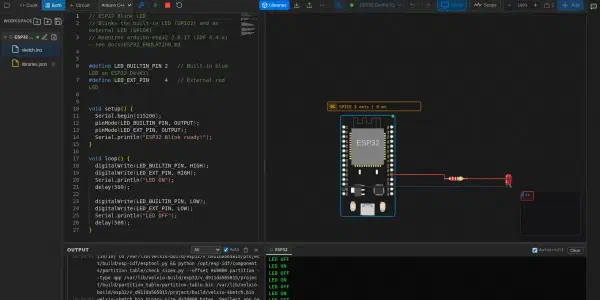
This article introduces Velxio, an open-source, browser-based embedded simulator that runs real ESP32 firmware on emulated hardware. It explains how the simulator works under the hood, demonstrates LED, Wi-Fi, MQTT, and sensor based projects, and highlights support for multiple boards across the ESP32 family.
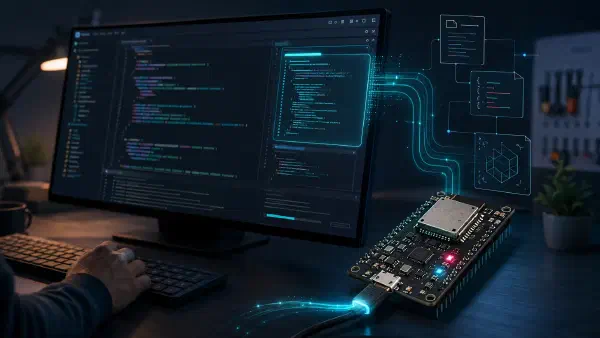
A hands-on workshop that teaches developers how to use AI coding agents to accelerate ESP-IDF firmware development, from environment setup and project scaffolding to component creation, debugging, and refactoring.
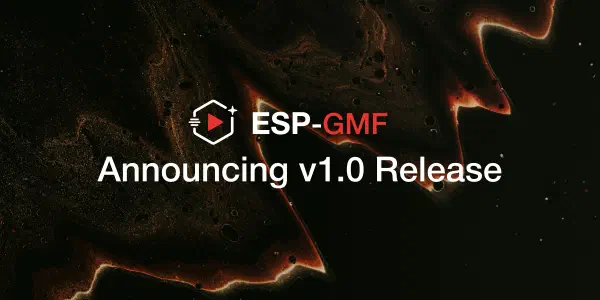
ESP-GMF v1.0 is the first official release of Espressif’s General Multimedia Framework, a lightweight, unified framework for building audio, video, and AI multimedia applications on Espressif chips. This post introduces the release, walks through what is new for each component area, and lists the full v1.0 component set.
Learn how to build edge AI vision applications on the ESP32-S3-EYE using ESP-WHO and ESP-DL. This hands-on workshop covers face detection, face recognition, hand gesture recognition, and object detection with real-time inference on the device.
Still on improving our AI-based, embedded software workflow, this article applies the same AI-agent discipline to Zephyr. Using the same ESP Dualkey kit from M5Stack, specs, integration rules, plan→execute→commit→test, reusable modules, journals, and Git - without redefining the product.
A first-person account of building an ESP32-C5 Arduino temperature indicator with AI assistance, from generated code and confusing errors to serial debugging, wiring issues, and the moment the LED finally changed color.
ESP-IDF v6.0 introduces the Tools local MCP server, a feature that lets AI clients like Cursor and Claude Code control your projects – setting targets, building, flashing, and checking status. This article explains how it works and walks you through setup step by step.
AI assistants are most effective on ESP32 Rust firmware when you supply clear specs, pinned crates, reference implementations (often ESP-IDF C), and a tight verify loop. The article discusses good practices, pitfalls, discipline, and entropy. A brief explanation about the device is also included, along with the repository and all artifacts.
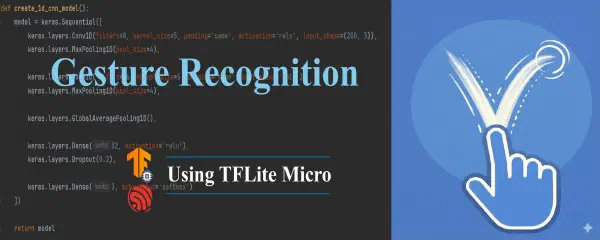
This article demonstrates how to implement gesture recognition using TensorFlow Lite Micro on Espressif SoCs. It covers the complete workflow from data collection and model training to model deployment, showcasing TensorFlow Lite Micro’s applications in edge AI.
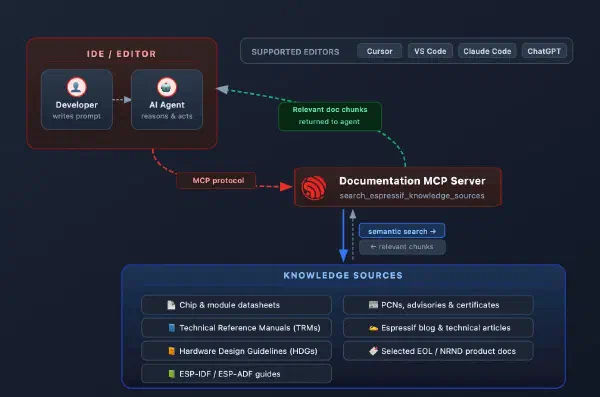
This article introduces how to connect your AI agent to official, up-to-date Espressif documentation directly inside your AI applications — with installation steps, example prompts, and best practices.
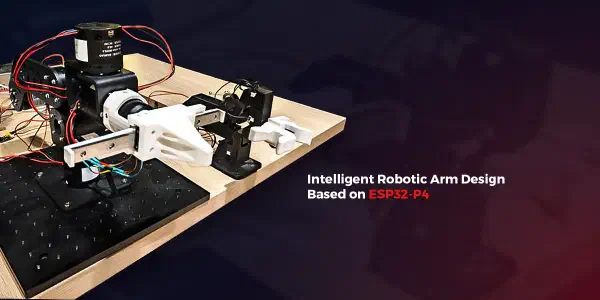
This article demonstrates how to implement an independently controllable robotic arm project based on the ESP32-P4 high-performance MCU. It covers complete kinematics, visual detection, and remote control, showcasing the great potential of ESP32-P4 in industrial applications.
Learn how Wokwi simulation and AI-assisted debugging solved a subtle RGB565 color mapping bug when porting Raylib to ESP32, turning hours of hardware debugging into an efficient iterative workflow with automated visual testing.
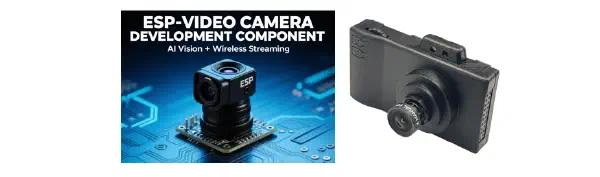
The esp-video component provides a solution to build camera applications on the ESP32 chips. This article will introduce the esp-video component, how to use it, and will give an overview of the framework around it.
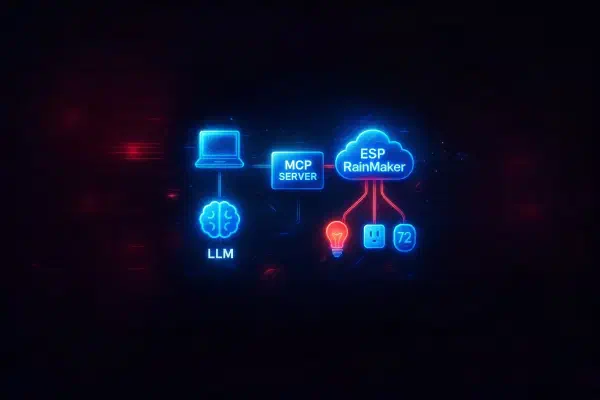
ESP RainMaker now supports the Model Context Protocol (MCP), enabling natural language interactions with your IoT devices via tools like Claude, Cursor, Gemini CLI, Windsurf, etc. This blog introduces the new stdio-based MCP server, outlines use cases, and hints at what’s next.
This article demonstrates how to implement a touchpad-based digit recognition system using ESP-DL on ESP32 series chips. It covers the complete workflow from data collection and preprocessing to model training, quantization, and deployment, showcasing ESP-DL’s capabilities in edge AI applications.