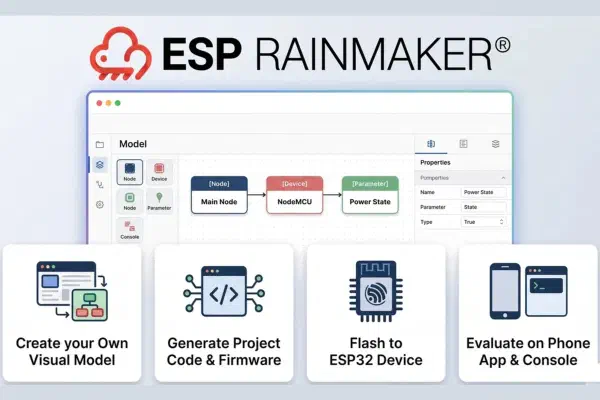
Learn to design an ESP RainMaker device data model using the Studio tool on Evaluation Hub, implement the ESP32-C3 hardware driver, and build, flash, and control a cloud-connected Rainbow LED from the ESP RainMaker Home app.
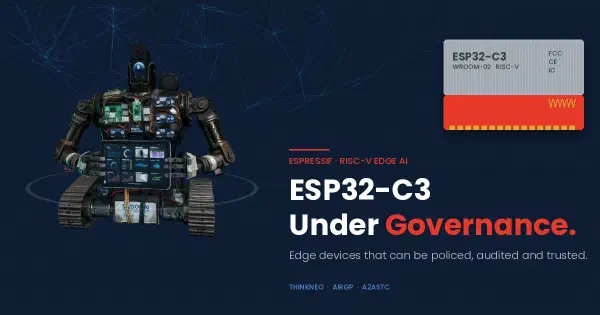
FOFOCA is an open-source reference design for an AI-governed household robot, built around a Raspberry Pi 5 brain, an ESP32 for real-time motor control and sensor polling, and an ESP32-C3 driving an OLED status display over MQTT. This article walks through the hardware architecture, the firmware running on each Espressif chip, and how all of it connects to a local edge AI server running NVIDIA Nemotron Nano 8B for inference — no cloud dependency required.
Hands-on embedded development with TinyGo and Go on ESP32 microcontrollers. Learn GPIO control, displays, sensors, Wi-Fi connectivity, and edge AI concepts through practical assignments.
This two-part guide shows how to set up VS Code with the ESP-IDF extension to debug Espressif boards using JTAG. In this second part, we will debug a simple project using gdb through Espressif’s VSCode extension. We will explore the debugging options for navigating the code and inspecting the variables.
This two-part guide shows how to set up VS Code with the ESP-IDF extension to debug Espressif boards using JTAG. This first part covers the debugging process, hardware setup and connections, and starting the openOCD server.
This tutorial guides you through setting up a soft-AP using an Espressif module and ESP-IDF. It covers the process of creating a project, configuring Wi-Fi, and handling connection events through event loops. Upon completion, you’ll be able to establish a soft-AP and manage Wi-Fi connections. It is the first step to building more advanced networking applications.