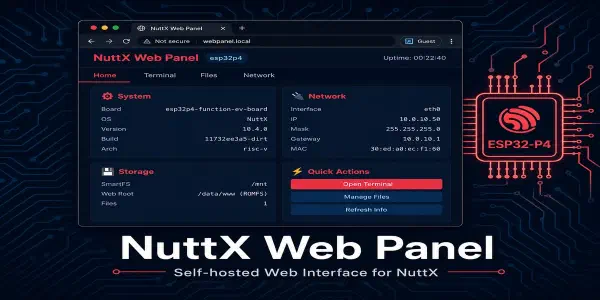
NuttX Web Panel is a self-hosted web interface for NuttX that provides system information, a browser-based NSH terminal, and file management. Combined with Python, it turns NuttX into a computing platform where interpreted applications can be developed and tested without recompiling code.
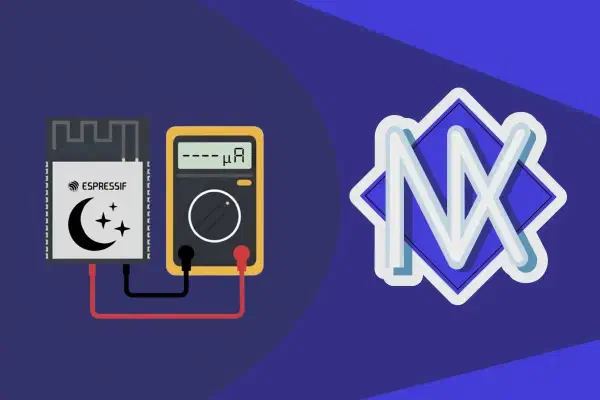
This article walks through Espressif power modes and NuttX power states, then explains how they map to each other. Then it introduces NuttX’s power management system and the concept of governors. The how-to part shows how to control sleep modes from the shell and a custom application. Finally, you will see real power‑consumption measurements across multiple ESP chips to illustrate the practical impact using power states.
This guide provides a practical getting‑started walkthrough for using MCUboot on ESP32. It covers step-by-step environment setup, bootloader building, application configuration, and flashing. It also gives an overview of MCUboot’s execution flow.
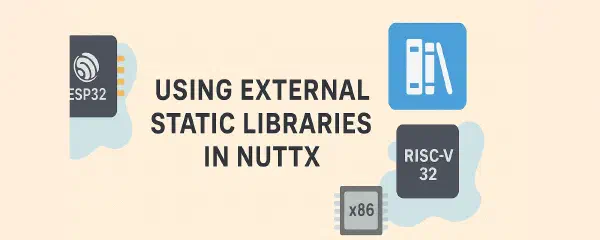
This guide demonstrates how to integrate external libraries into NuttX applications using static libraries and cross-compilation. Learn how to build a library on x86, integrate it into the NuttX simulation environment, and cross-compile for RISC-V targets like the ESP32-C6, all without moving your entire codebase into the NuttX directory structure.
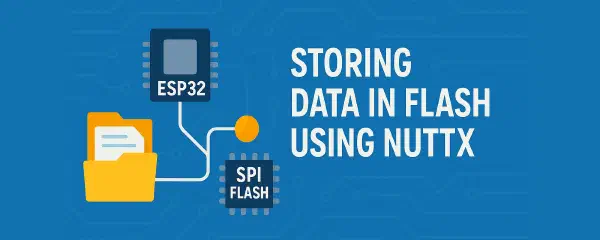
This guide explores how to utilize flash memory for persistent data storage in NuttX-based embedded systems, covering SPI Flash fundamentals, file system options (SmartFS, SPIFFS, LittleFS), and practical implementation of a boot time logging application with Wi-Fi and NTP synchronization.
This article extends the NuttX motor control system with inertial measurement unit (IMU) sensor integration for vibration measurement and wireless data streaming capabilities using the ESP32-C6 Wi-Fi connectivity.
In this article, we explore a simplified ESP32 boot process using single-image binaries to speed up build and flash times — ideal for development workflows. This approach sacrifices features like OTA updates but enables faster iteration.
This article demonstrates how to implement motor control and speed sensing on an ESP32-C6 using NuttX RTOS. It covers setting up MCPWM for motor control, ADC for potentiometer reading, and quadrature encoder for speed measurement. The implementation showcases NuttX’s real-time capabilities through a practical example using common peripherals and sensors.